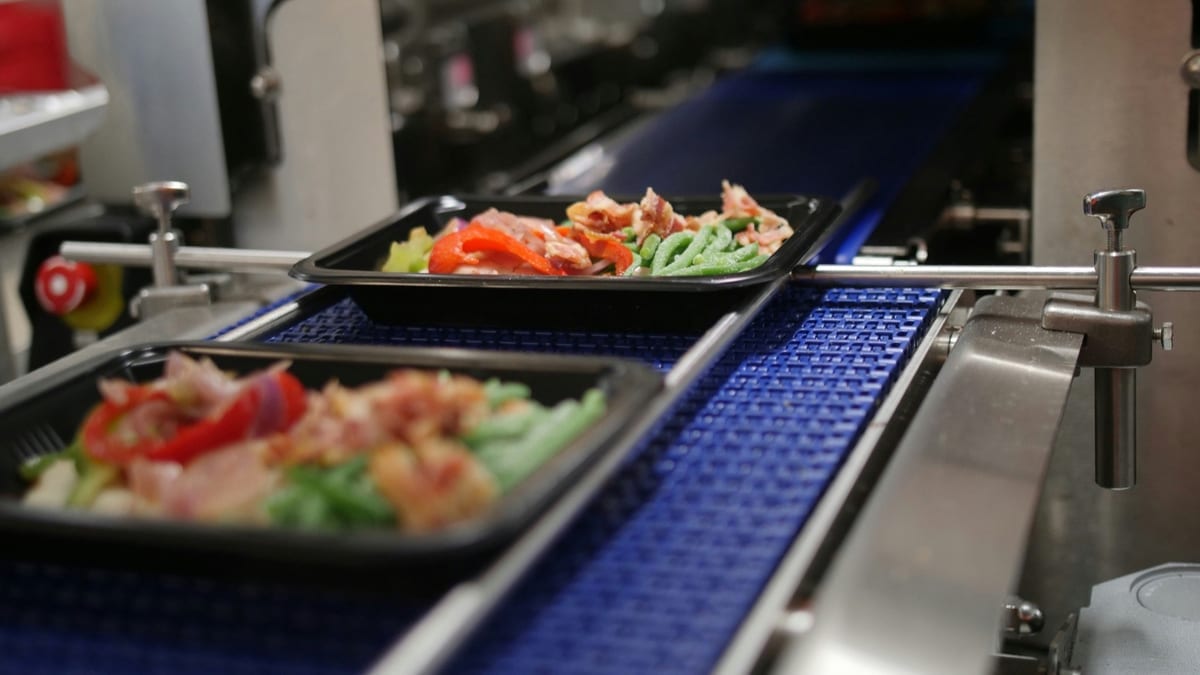
A regional food manufacturer was rejecting product manually at the end of the line. We replaced the process with inline machine vision and cut false-reject rate by 73%.
A regional food manufacturer running three packaging lines was losing 4 to 6 percent of finished product to manual end-of-line inspection. The process relied on two inspectors per shift visually checking fill level, seal integrity, and label placement at roughly 200 units per minute. Fatigue, shift handoffs, and ambient lighting inconsistency were driving false reject rates well above industry norms — good product was being thrown away at a rate that was costing the facility more than the defects themselves.
Manual Inspection at Speed Is Not a Quality System
At 200 units per minute, each unit passes a stationary inspector in under a third of a second. A trained inspector can reliably catch gross defects — a missing label, an obviously underfilled container, a seal that failed completely — but consistent detection of marginal defects at that throughput rate is physiologically impossible over the course of a shift.
The client's internal data bore this out. Their reject rate varied by as much as 2x between morning and evening shifts: the morning crew, fresher and working in better lighting conditions, rejected at roughly 3.8 percent. By late afternoon on the evening shift, the reject rate climbed to 6.2 percent. The overage wasn't catching more defects — the defect rate in the product itself was relatively stable. The variability was entirely in the inspector's sensitivity threshold drifting upward as fatigue accumulated.
End-of-line rework was consuming 11 percent of total labor hours across the plant. Each false reject unit had to be retrieved from the reject bin, re-inspected by a lead, and either cleared back to inventory or genuinely condemned. At the facility's throughput volume, that rework cycle added up to several hundred labor-hours per month with no quality benefit.
There was also a compliance dimension. The facility ran under SQF Level 2 certification and had a retailer-mandated audit requirement for inline inspection documentation. Manual inspection records — paper logs maintained by shift leads — were inconsistent in format and difficult to audit. A GFSI auditor had flagged the inspection documentation process as a minor nonconformance in the prior year's audit, with a recommendation to move toward electronic verification records.
The facility had evaluated a commercial vision system from a major vendor two years prior. The quote came in at roughly $400,000 installed — $160,000 for the vision hardware and software, $180,000 for the vendor's integration service, and $60,000 for a dedicated workstation, proprietary licensing, and a first-year support contract. At that price, the ROI didn't justify deployment on a single line, and the vendor wouldn't deploy on a fractional basis. The project was shelved.
What We Built
We designed a three-camera inline inspection station integrated directly into the existing Allen-Bradley ControlLogix 5580 control system. The station operates inline, immediately before the carton packer, inspecting every unit at full line speed without requiring a dedicated inspection conveyor or speed change.
Each camera handles a distinct inspection function:
- Fill level: A backlit line-scan camera positioned below the conveyor belt images each container from beneath. Fill level is measured by comparing the liquid surface shadow profile against the calibrated baseline for each SKU. Underfill greater than 3 percent triggers reject; the threshold is configurable per SKU.
- Top seal integrity: A structured-light camera positioned above the conveyor projects a laser line across the seal area. Seal failures — incomplete fusion, edge lifts, and foreign material under the seal — appear as deviations in the reflected line profile. The structured-light approach is insensitive to container surface color variation, which had made contrast-based seal inspection unreliable for this facility's SKU range.
- Label registration: A high-resolution area-scan camera with programmable ring illumination detects label presence, placement position within tolerance, and barcode readability. Label skew greater than 2mm from the centerline triggers reject; missing barcodes or unreadable barcodes route to a hold queue rather than an automatic reject to enable manual verification.
Vision processing runs on an embedded Cognex In-Sight 9000 series industrial PC mounted inside the existing control panel. Decision output — pass, reject, or hold — communicates to the ControlLogix PLC over EtherNet/IP at a cycle time of under 8ms, well within the reject diverter actuation window at line speed. Rejects trigger a pneumatic diverter already installed on the conveyor that had previously served only metal detection faults.
The HMI overlay was built in FactoryTalk View Site Edition, surfacing reject counts categorized by fault type (fill, seal, label), camera status and calibration state, last-calibrated timestamp for each SKU, and a live thumbnail cache of the 10 most recent rejects with fault type labeled. Operators can toggle inspection sensitivity by fault type and product SKU from the HMI without requiring access to the Cognex In-Sight configuration environment.
A structured inspection event log writes to the facility's historian for every unit inspected — pass or reject — including timestamp, fault type if applicable, and the SKU active at inspection time. This log satisfies the electronic verification record requirement flagged in the prior SQF audit.
Integration and Commissioning
The binding constraint was line uptime. The facility runs two shifts Monday through Saturday with a six-hour planned maintenance window on Sunday mornings. All work that required line downtime had to fit within that window.
We structured the installation in two phases. Phase one — camera mounting hardware, lighting fixtures, and cable runs — was completed during production using the adjacent shift time window, with no impact on line operation. The pneumatic diverter and PLC logic additions required a brief line stop; both were completed in the first Sunday maintenance window in under three hours.
Commissioning ran over four consecutive Sundays:
- Sunday 1–2: Camera calibration and vision model training across the full active SKU range (22 SKUs at deployment time). Each SKU required calibration of fill thresholds, label position tolerances, and seal profile baselines. The structured-light seal camera required additional calibration time for three SKUs with foil-laminate top seal material, which has a different reflectance profile than the standard polyethylene heat seal.
- Sunday 3: PLC integration testing, EtherNet/IP timing verification at line speed, and HMI configuration. Reject diverter actuation timing was set and verified against measured conveyor velocity to confirm accurate unit targeting at 200 units per minute.
- Sunday 4: Full production trial with an engineer on-site. The quality manager participated in the trial and conducted parallel manual spot-check against the vision system's reject decisions.
By the end of the production trial, the system had processed 14,000 units. The vision system's false reject rate was 0.9 percent against a manual baseline of 3.4 percent on the same SKU mix. True defect catch rate matched manual inspection on confirmed defect units in the sample.
Three SKUs required post-trial calibration adjustments — two for fill level threshold refinement and one for label position tolerance that had been set too tightly against the client's incoming label stock variation. All three were resolved before the following Monday's production start.
Results
Three months post-deployment, the false reject rate sits at 1.1 percent — a 73 percent reduction from the pre-installation 3.4 percent baseline. True defect catch rate is 99.2 percent across all three fault types, verified against manual spot-check sampling conducted weekly by the quality team.
- False reject rate: 3.4% baseline to 1.1% current (73% reduction)
- True defect catch rate: 99.2% (vs estimated 96-97% for manual inspection under optimal conditions)
- Shift-to-shift reject rate variance: eliminated — inspection consistency is now independent of shift timing
- Labor redeployed: 2 FTEs per shift (4 total) redirected to other production roles
- SQF inspection documentation nonconformance: resolved — electronic records now generated automatically for every unit
- Estimated payback period: under 14 months at current throughput, including installation and engineering cost
The system has been replicated on a second line at the same facility. A third line is currently in the evaluation phase.
Why the Commercial Quote Failed and This Didn't
The $400,000 commercial system quote included significant overhead that had nothing to do with the inspection problem. A dedicated HMI workstation running a proprietary vision application separate from FactoryTalk created a second interface that operators had to learn and maintain. The vendor's communication bridge between the vision system and the ControlLogix PLC added 45ms of latency to the reject decision — marginal at lower line speeds, but a real timing problem approaching 200 units per minute. The proprietary licensing model meant any SKU configuration change required either a trained vision technician or a service call.
Our approach kept the architecture as flat as possible: vision processing lives close to the hardware, the PLC receives a binary signal over native EtherNet/IP at the same scan rate as any other I/O module, and operators configure SKU parameters through the FactoryTalk HMI they already use every day.
The SKU flexibility was a deliberate design priority, not an afterthought. A vision system that requires a specialist to reconfigure for each product changeover gets abandoned within a year — not because it doesn't work, but because it creates a dependency that production can't tolerate. The operator-facing SKU configuration in FactoryTalk allows the quality team to manage the full SKU library independently. Since deployment, the facility has added seven new SKUs to the active lineup without any engineering involvement.
Ongoing Performance and Calibration
Vision systems degrade quietly if calibration is not maintained. Lighting changes seasonally as ambient conditions shift. Packaging material specifications drift within tolerance bands between supplier runs. Conveyor belts wear and change their reflectance profile.
The system includes an automated calibration drift monitor that compares daily inspection statistics against each SKU's calibration baseline and flags SKUs where the reject rate has shifted more than 0.5 percentage points from the rolling 30-day average. This catches gradual degradation before it becomes a false reject problem rather than after.
Calibration checks for each active SKU are scheduled quarterly and take approximately 20 minutes per SKU using the operator-facing HMI workflow. The quality team handles these independently without engineering support.
The structured inspection log also provides a continuous process feedback signal: trending increases in a specific fault type — seal failures increasing over a two-week window, for instance — are visible before they rise to the level of a quality hold, allowing the production team to investigate a potential upstream cause (sealer temperature drift, incoming seal material lot change) proactively rather than reactively.