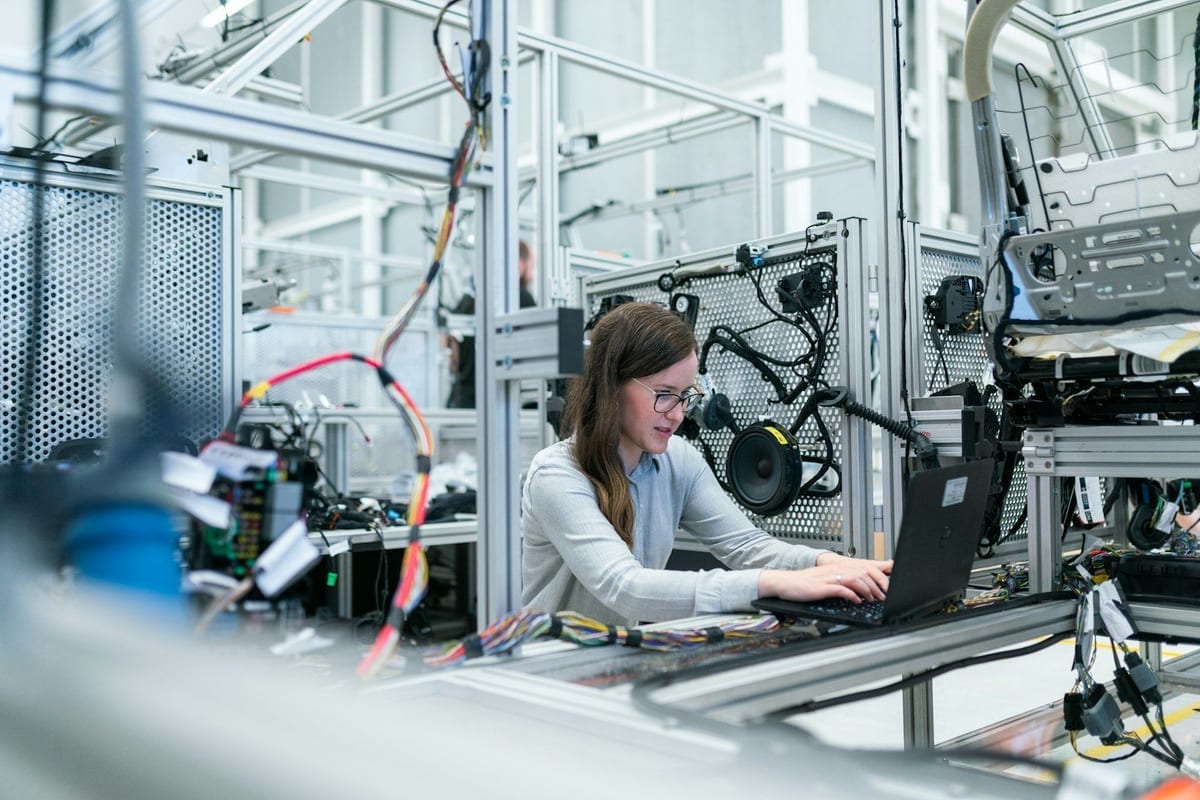
American engineers are not less skilled than their counterparts in Chinese factories. The facilities they work in are less capable. That difference matters because it points to a different solution.
The framing that appears most often in discussions of US manufacturing competitiveness is some version of a skills crisis: not enough engineers, too many unfilled technical roles, a workforce that hasn't kept pace with the demands of modern production. The data on open positions supports part of this. The conclusion drawn from it usually doesn't.
The factories where Chinese production outpaces American production are not staffed by more capable engineers. They're built on newer infrastructure, with faster capital reinvestment cycles, and with tooling and software purchased this decade rather than three decades ago. That is a different problem than skill, and it responds to different solutions.
The Greenfield Advantage
A significant share of Chinese manufacturing capacity was built in the last 20 years. Plants designed in that window incorporate modern IIoT infrastructure, current-generation automation platforms, and integrated MES and ERP systems from the start. There's no brownfield constraint: no legacy DCS requiring re-architecture for a process change, no proprietary historian unsupported since 2011, no electrical infrastructure sized for equipment retired years ago.
US manufacturing capacity is predominantly brownfield. The average age of a US manufacturing facility exceeds 25 years. That is not a workforce problem. It's a capital allocation problem that compounds over time as tooling ages, integration gaps widen, and the cost of modernization grows.
The compounding dynamic matters: a facility with a 25-year-old control architecture that has deferred one controls upgrade has a harder time justifying the next upgrade because the retrofit scope is now larger than it would have been. The cost of modernization grows faster than the underlying equipment ages. Plants that defer systematically end up with gaps that require multi-year programs to address, rather than incremental upgrades that could have been absorbed into normal maintenance cycles.
The Tooling Infrastructure Deficit
Modern production runs on software: MES for execution, ERP for scheduling and inventory, SCADA for supervision, quality management systems, OEE tracking, and predictive maintenance platforms. In well-capitalized, recently built facilities, these systems are integrated by design. In facilities built incrementally over decades, they're frequently not integrated at all.
The specific gaps that appear most consistently:
MES to ERP disconnects. Production data generated by the MES (actual quantities, scrap, cycle times, downtime events) doesn't flow automatically to the ERP. Shift boundaries require manual reconciliation. Inventory accuracy suffers. Production orders get closed based on planned quantities rather than actual counts. The labor cost of reconciliation is invisible in the P&L but real in headcount, and the data quality problem compounds into inaccurate planning.
Quality data isolation. Quality data captured on paper or in standalone systems isn't linked to process historian data. When a batch fails incoming inspection, nobody can quickly answer whether the process ran within spec, which parameters were elevated, or whether this failure pattern has appeared before on similar batches. Answering those questions requires manual correlation across systems, typically taking hours rather than minutes.
OEE calculated manually. Overall equipment effectiveness calculated by shift supervisors in Excel rather than derived from actual machine data is a lagging indicator based on estimates. Real-time OEE from PLC data surfaces the actual breakdown between availability, performance, and quality losses, enabling targeted improvement rather than guesswork. The difference isn't just convenience: OEE calculated from estimates systematically overstates performance because supervisors round up and miss short stops.
Maintenance systems disconnected from control systems. A CMMS that doesn't communicate with the PLC controlling the equipment it tracks cannot receive automated work order triggers from equipment run-time or fault history. Preventive maintenance schedules run on calendar time rather than actual equipment condition. Equipment with low duty cycle is over-maintained; equipment running near its limits is under-maintained. The maintenance cost is the same; the reliability outcome is worse.
Alarm systems never rationalized. Alarm systems in many facilities haven't been reviewed since commissioning. Hundreds of configured alarms with no priority structure generate operator desensitization. The EEMUA 191 guideline of one alarm per 10 minutes during normal operations is a standard many plants exceed by a factor of five to ten during process upsets, which means operators are triaging rather than responding. Root cause identification in alarm floods takes time that the process doesn't have.
The engineer working in this environment isn't less capable. They spend meaningful time working around gaps that shouldn't exist. The output difference between a well-tooled operation and a poorly tooled one compounds across every shift, every production run, every engineering change order.
The comparison that matters isn't the US workforce versus the Chinese workforce. It's a 2005 facility running 2005 infrastructure versus a 2019 facility running 2019 infrastructure. The skill differential between those workforces is small. The capability differential between those environments is large.
Capital Reinvestment Patterns
China's manufacturing advantage is significantly attributable to state-directed capital deployment. Investment cycles are faster, reinvestment mandates are structural, and the decision to upgrade a facility doesn't have to survive a multi-quarter internal ROI approval process. A Chinese facility that needs a new vision inspection system or a controls upgrade can move faster than the equivalent US facility can get budget sign-off.
This isn't an argument for state direction of US manufacturing investment. It's an observation about the organizational dynamics that produce different investment decisions. US manufacturers that treat automation and tooling investment as discretionary OpEx rather than infrastructure maintenance consistently fall behind peers who treat it as capital maintenance. The decision to defer a controls upgrade or delay an MES integration doesn't eliminate the cost. It defers it with compounding interest.
The ROI framing that tends to unlock capital allocation for modernization projects isn't "what is the return on this upgrade" but "what is the cost of not doing this upgrade." Deferred maintenance of control infrastructure has quantifiable costs: increased maintenance labor, slower fault resolution, reduced production flexibility, higher scrap rates from processes that can't be monitored or adjusted in real time. Those numbers, assembled from actual production data, make the case for modernization in terms that capital allocation processes can evaluate directly.
Where Industrial Software Investment Lives
The other structural factor rarely surfaced in US manufacturing competitiveness discussions is the industrial software supply chain. The dominant automation platforms are German (Siemens, Beckhoff), Japanese (FANUC, Yaskawa, Keyence, Mitsubishi), or increasingly Chinese. US-headquartered industrial software companies exist, but platform-level tooling for controls, motion, and industrial networking is heavily concentrated outside the US.
This matters because the integration depth, development velocity, and tooling maturity of an automation ecosystem is shaped by where its primary development investment sits. Allen-Bradley's continued market dominance in North America (Rockwell Automation is headquartered in Milwaukee) is a partial counterweight, but Rockwell's integration ecosystem with modern cloud and analytics platforms has historically lagged European competitors. Siemens' TIA Portal and its integration with MindSphere; Beckhoff's EtherCAT-based architecture with its high-speed real-time performance; FANUC's robot programming ecosystem with integrated vision and force control: these platforms are where significant development investment has concentrated.
The practical implication: best-in-class tooling for industrial data analytics, IIoT connectivity, and control system modernization increasingly requires engagement with non-US platforms. Ignoring them to maintain perceived sourcing simplicity leaves capability on the table.
What Closing the Gap Actually Requires
The workforce pipeline investment that dominates policy discussions is necessary but not sufficient. You can produce more skilled engineers and technicians and deploy them into facilities that are structurally constrained by aging infrastructure. The throughput improvement will be real but limited by what the facility can support.
The larger lever is capital allocation toward facility and tooling modernization. The specific sequence that produces results in brownfield environments:
Phase 1: Data visibility. Getting real-time data from production assets into a unified historian or data platform. This typically requires OPC-UA or MQTT edge gateways for equipment without native connectivity, updated communication modules for PLCs that have them available, and a historian platform (Ignition, OSIsoft PI, or cloud-based alternatives) that can accept the data and make it queryable. Data visibility is the prerequisite for everything that follows. Analytics built on data you don't have access to are not analytics.
Phase 2: Integration. Connecting the historian to the MES, quality systems, and CMMS. Establishing automatic work order generation from equipment condition data. Building real-time OEE calculation from actual machine data rather than manual input. Linking quality data to process historian data so failure investigations take minutes rather than hours. The integration work is not technically complex; it's organizationally complex because it requires agreement across teams about data ownership and access patterns.
Phase 3: Analytics. With integrated data available, deploying production analytics becomes practical. SPC on key process parameters, predictive maintenance models from vibration and temperature data, correlation analysis between process parameters and quality outcomes. At this phase, AI-powered automation and agentic tools that surface insights without requiring analysts to query data manually become viable. Phase 3 without Phase 1 and Phase 2 produces analytics running on incomplete, disconnected data.
None of this requires novel technology. Most of it requires investment decisions that have been deferred. The engineering talent to execute this work exists in the US. The willingness to fund the infrastructure it runs on is the variable.
Modernization as a Competitive Strategy
Manufacturers that have closed the competitiveness gap with overseas production share a consistent pattern: they treated modernization as infrastructure maintenance rather than one-time capital projects, they invested in data visibility before analytics, and they built internal competency in their automation platforms rather than depending entirely on vendor support.
Facilities that are losing ground share a different pattern: modernization projects are scoped as large capital projects requiring multi-year ROI justification before any investment is approved, data visibility is treated as a future aspiration rather than a current operational requirement, and control system knowledge that enables rapid troubleshooting and improvement is concentrated in a small number of staff rather than distributed across the engineering team.
The gap between those two patterns is not a skills gap. It's a capital allocation and organizational priority gap that manifests as a capabilities gap over time. The engineering investment required to close it is real but not extraordinary. The organizational investment required to prioritize it consistently is the harder problem.
Framing the problem as a skills gap, rather than a tooling gap, keeps the focus on the wrong constraint and leaves the larger opportunity unaddressed. The US manufacturing workforce is capable of producing competitive output. The infrastructure that workforce operates in is the variable that most determines whether it does.